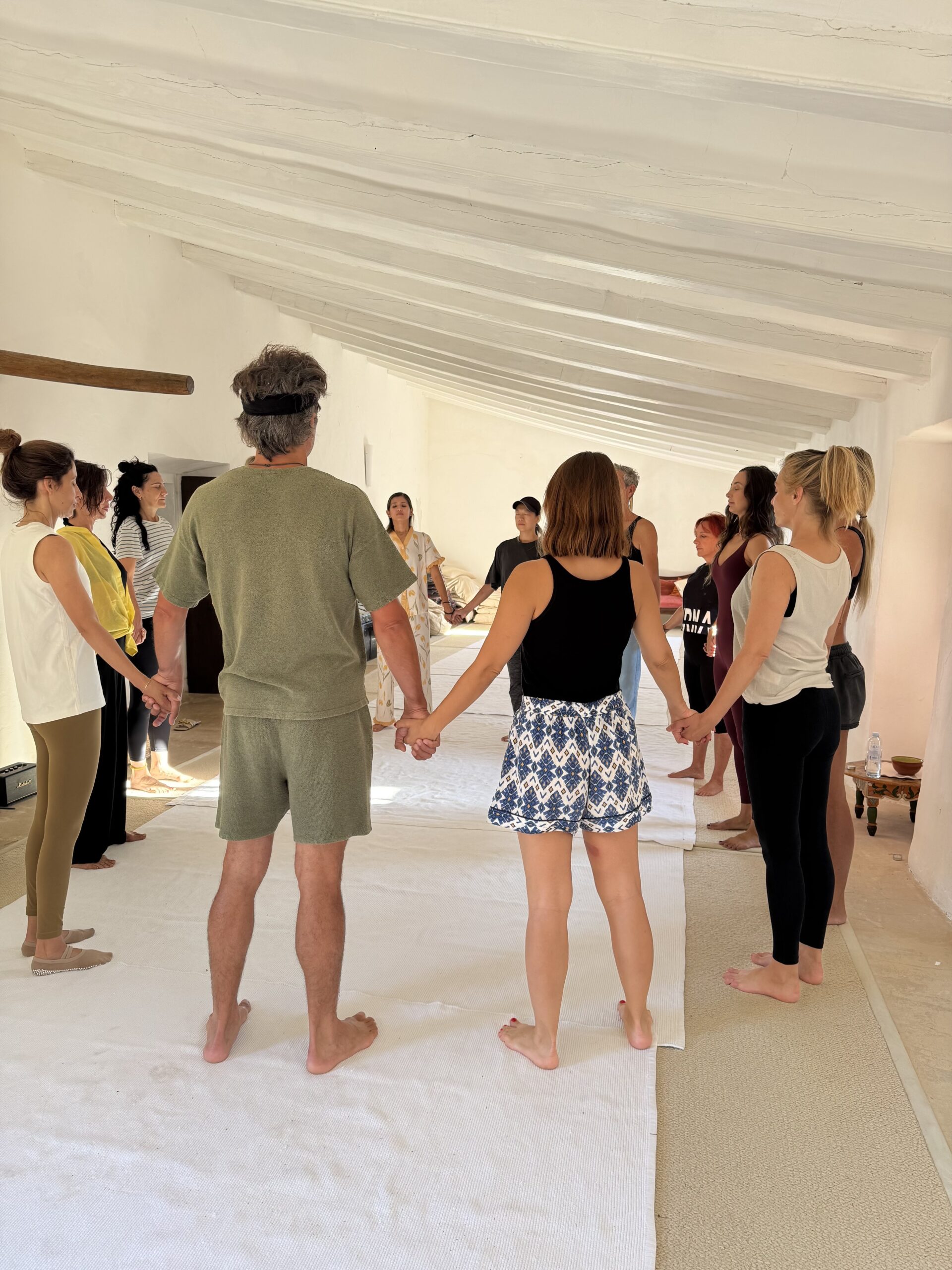
Deià, Mallorca. April. Four days held in Son Rullan, a fourteenth-century monastery in the mountains above the village, with ancient stone walls, olive terraces that have been tended for centuries, sea air moving through open windows, birdsong in the early mornings, wild paths through the garrigue, and that particular Mallorcan light that seems to soften the edges of everything it touches.
Some places hold people before the deeper work even begins. Son Rullan is one of them. The atmosphere of a place that has stood for seven hundred years, that has witnessed, in its walls, generations of human experience, of difficulty and devotion and ordinary life, communicates something to the nervous system that newer, purpose-built retreat spaces rarely can. There is a quality of settledness to old stone that I find both difficult to articulate and consistently observable in the people who arrive into it.
The container matters
In BioHarmony, we pay significant attention to the vessel before we attend to its contents. The physical environment, the quality of attention brought to every detail of the experience, the sense of genuine care in the practical arrangements, food, space, timing, the composition of the group, these things are not aesthetic extras. They are biologically relevant.
The nervous system reads safety through the senses continuously and involuntarily. A space that feels held, that communicates through its light, its sound, its temperature, its aesthetic coherence, the obvious care that has gone into it, signals safety at a level beneath conscious cognition. And safety is the precondition for everything else. Without it, the deeper work is simply not available. The system stays defended. The guard stays up. The experience remains pleasant but superficial.
Creating a genuine container is therefore not about luxury. It is about function. When the environment communicates safety clearly enough that the body can actually let go of its vigilance, the quality of what becomes possible is different in kind, not just in degree.
The team and the work
Across four days, a small, carefully chosen team, myself, Boniface Verney-Carron, Mia Forbes Pirie, along with somatic practitioners Presence Embodied and Anika of The Mystic Breath, held a BioHarmony retreat container for a small, equally carefully selected group of participants.
The word “container” is important. It is borrowed from therapeutic and somatic traditions, and it names something precise: a bounded space with sufficient safety, care, and skill that people can encounter difficult material without being overwhelmed by it. Not a space where everything is comfortable, genuine growth rarely is, but a space where the conditions for transformation are present and the support is real.
The intention was not to deliver content, in the sense of information transfer. It was to create conditions: for release, for softening, for introspection, for the kind of embodied learning that settles into the body and stays, rather than the kind of intellectual learning that is interesting in the moment and fades within a week.
Breathwork formed a significant part of the four days. Conscious connected breathing, facilitated with skill, held within music chosen for its specific emotional and somatic effects, gives us direct voluntary access to an otherwise involuntary system. The autonomic nervous system governs digestion, immune function, sleep, the stress response, and the baseline regulatory tone of the body. Breath is the only aspect of this otherwise involuntary system that is accessible to conscious control. Used skillfully, it becomes one of the most powerful tools available for accessing states that ordinary waking life cannot reach.
Specific movement patterns, not exercise, but movement chosen and sequenced for its effect on the nervous system: grounding through the feet, orienting through the gaze, discharging held physical tension, activating the social engagement system, returning the body to a felt sense of presence. These are not arbitrary choices. They are drawn from somatic traditions and from the growing research base in somatic experiencing and sensorimotor approaches to regulation and trauma resolution.
Bodywork, physical, skilled, attuned, addressing the body as a repository of experience. Years of research in somatic and trauma-focused therapies have established clearly that experience, including difficult, unresolved experience, is held in the body in patterns of tension, bracing, and habitual posture that cannot be reached by talking alone. Skilled bodywork, when offered in a context of genuine safety and consent, can address these patterns directly.
Nature immersion, hikes through the mountain landscape above Deià, sea swims in the coves below, time simply sitting with the landscape. This is not incidental. The research on the physiological effects of time in natural environments is now substantial: cortisol reduction, improved parasympathetic tone, lower inflammatory markers, reduced activity in the brain regions associated with rumination and threat monitoring. Nature is genuinely regulatory, and using it deliberately within a retreat context amplifies the effect of every other element.
Group dynamics, the work that happens between people, facilitated and held carefully. This is perhaps the dimension most consistently undervalued by the optimisation world, which tends to centre the individual as the primary unit of health. The group becomes a mirror, a container, a source of regulation, and a vehicle for experiences, of being witnessed, of witnessing, of recognising oneself in another, that individual practice simply cannot replicate.
What shifted
BioHarmony is something we build over time: a deeper understanding of what lifts us and what drains us. In biological terms, what is anabolic — building, restorative, vitalising — and what is catabolic — depleting, stress-driven, slowly erosive. So much of chronic ill-health traces back not to a single cause but to the accumulated weight of the catabolic side of this ledger, the patterns, behaviours, and relational dynamics that quietly chip away at the system without ever producing a single dramatic event to explain the deterioration.
The retreats that stay with people are rarely the ones where the content was most impressive or the techniques most novel. They are the ones where something unexpected moved, something internal, something that had been held in place by the ordinary pace and pressure and requirement to appear competent that most professional lives impose.
In Deià, participants encountered parts of themselves they had kept at a distance. Not through confrontation or therapeutic pressure, but through the gentler invitation of space, safety, time, and the presence of others doing the same thing alongside them.
I have held enough of these spaces to know that this is consistently what happens when the conditions are right. People do not need to be pushed into their own depth. They need to be given permission and safety to descend there. When those things are genuinely present, people go, because there is something in them that wants to.
Why this is clinical medicine
I want to anchor this plainly, because I am aware that what I have described can sound, to ears trained in conventional biomedical frameworks, like it belongs in a different category from medicine.
It does not. It belongs at the centre of it.
Longevity research is increasingly clear that the quality of our relationships, our capacity for emotional regulation, our sense of belonging, and our ability to express what is true without shame are not peripheral to health outcomes. They are central to them. Social isolation now carries documented health consequences equivalent to smoking heavily. Chronic emotional suppression is associated with elevated inflammatory markers, cortisol dysregulation, and accelerated biological ageing by every measure we currently have.
The BioHarmony retreats are not a departure from clinical medicine. They are an extension of it into the territory where the data consistently points but where conventional medicine has lacked the tools, the frameworks, and the time to go.
The next retreat in Deià begins 29 October, 2026. There are a small number of places available: https://wellgevity.com/wp-content/uploads/sites/62699/2026/07/V1_Oct-Nov-2026-Lived-Bioharnony-Retreat_Deia.pdf
BioHarmony retreats are held by Dr Tam and Boniface Verney-Carron, with a curated team of specialists. The next Deià retreat begins 29 October, 2026. For details and to enquire, visit wellgevity.com/retreats.

Comments will display here